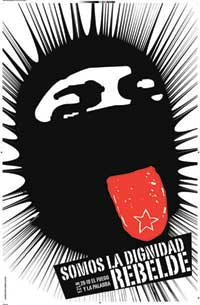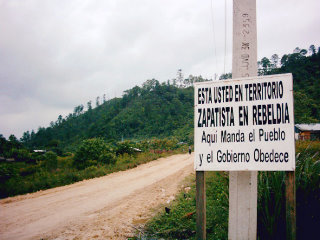
Parallel to the struggle between PRI, PAN, and PRD for votes in the upcoming (July) Mexican presidential elections, the Zapatistas are conducting what they term an
"Other Campaign". They launched this campaign last year with their
"Sixth Declaration of the Selva Lacandona" (Spanish text
here).
In the midst of all the regional excitement about the Left's victories in successive elections--Venezuela, Brazil, Uruguay, Bolivia, Chile--here, then, is one group that is continuing, and indeed stepping up, its extra-parliamentary activism.
Not that this is any coincidence. The Colectivo Situaciones hit the nail on the head when they write:
In effect, the Sixth Declaration is a much-needed text that aims to interrupt a definite tendency [deriva]: a tendency that orients the energies and victories of the past few years' struggles towards a revitalization of forms of sovereignty that are still trapped within traditional modes of representation, and that has succeeded, in line with the movement of the times, to construct a hypothesis appropriating the potential of the present situation by means of an affirmation of and from insurgent movements. (Bienvenidos a la selva 22-23)
In other words, if Chávez, Lula, Morales, and Bachelet are, in their different ways, instances of the conversion of constituent into constituted power, a constituted power that by definition blocks an analysis and critique of the form of power itself, the Zapatistas' Sixth Declaration is intended to derail that mechanism, and to rethink a politics that would extend rather than halt the process of constitution.
Hence the Zapatistas' stress on autonomy, self-government, and even their self-critique, suggesting that they they themselves had subordinated grassroots empowerment to the politico-military structure of the EZLN.
Rather than vertical consolidation, the Sixth Declaration insists on the importance of undoing all residual or incipient transcendence. It envisages, indeed, the dissolution of the EZLN itself, its subsumption into a plane of immanence: "perhaps it would be better with nothing below, just completely level [
puro planito todo], without any military, and that is why the zapatistas are soldiers so that there will not be any soldiers" (332). Instead of building up, the Zapatistas are expanding outwards.
And John Holloway is right to note that this expansion is not envisaged in terms of
solidarity, though "this has always been an element of the response to the Zapatistas: admiration for
them, solidarity with
them" (317; emphasis in original). Holloway continues:
The pro-Zapatista movement has always included two elements: the element of solidarity with an indigenous struggle, on the one hand, and taking on the struggle for humanity and dignity as our own struggle, on the other. My feeling is that with the Sixth Declaration and the abandonment of indigenous rights as principal focus of the EZLN's struggle, they are telling us "We've always said that behind the ski-masks we are in fact you, but perhaps you didn't understand this so well, so we'll say it to you more directly and in another way." (317)
The Zapatistas make this point playfully, joking with the conventions of solidarity. They promise to send a lorryload of maize to Cuba, in a lorry called "Chompiras," so long as a convenient place can be found for the transaction, and so long as the Cubans can wait until harvest. They suggest sending crafts and coffee to Europe. They debate doing more:
And perhaps we might also send you some pozol, which gives much strength in the resistance, but who knows if we will send it to you, because pozol is more our way, and what if it were to hurt your bellies and weaken your struggles and the neoliberals defeat you. (345)
The Zapatistas seek to expand and intensify their network, playfully, creatively, and performatively. And despite certain populist resonances in their vocabulary, it's this deterritorializing and excessive (because
symbolic?) tendency that marks their break from such state fetishism.
technorati tags:
political theory multitude mexico zapatistas